
About IDRiM Conference
The Integrated Disaster Risk Management (IDRiM) Conference is a leading international forum that brings together researchers, practitioners, policymakers, and civil society to advance knowledge and practice in disaster risk reduction and resilience.
Held annually in different regions of the world, the IDRiM Conference provides a platform to exchange cutting-edge research, share lessons from practice, and foster collaboration across disciplines and sectors. The conference emphasizes integrated approaches, connecting science, policy, financing, communication, and community action to address complex and multi-hazard risks.
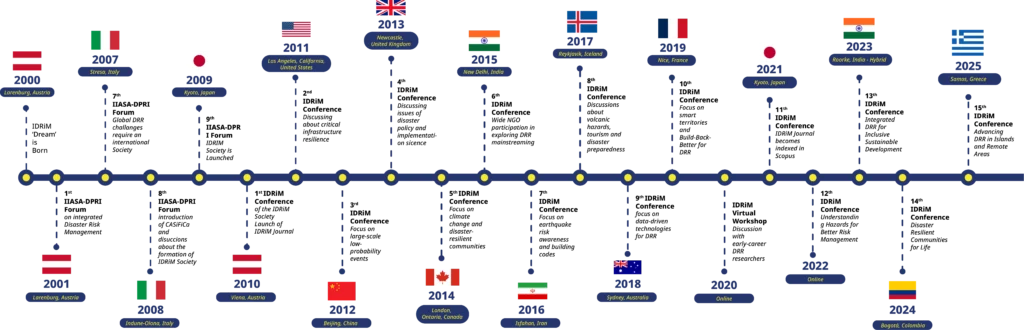
Through keynote lectures, oral presentations, panel discussions, and interactive sessions, IDRiM promotes dialogue on what works in real-world disaster risk management, supporting evidence-based decision-making and inclusive, locally grounded solutions.
The 16th IDRiM Conference (IDRiM 2026) will be hosted in Bali, Indonesia, continuing the conference’s commitment to regionally rooted yet globally relevant discussions on resilience in an increasingly uncertain and interconnected risk landscape.
Concept Note
The Concept Note serves as the foundational reference for IDRiM 2026. It outlines the conference’s background, theme, objectives, and key focus areas, providing the guiding framework for contributors, partners, and participants. Please refer to the full document below for detailed information that will support your preparation for abstracts, session proposals, and other contributions.
Theme
As cities face increasingly complex and overlapping hazards, bridging the gap between knowledge and action has become critical. IDRiM 2026 provides a global platform to connect scientific innovation, implementation science, and grassroots practice, ensuring that advances in disaster risk management translate into effective and inclusive solutions on the ground.
Theme: Resilient Cities in Multi-Hazard Crises: Bridging Innovation, Implementation Science, and Grassroots Action
- Track 1: Multi-Hazard Preparedness and Risk Assessment
This track aims to develop integrated approaches of implementation science to policy. The methods applied may include, but are not limited to, remote sensing applications, scenario-based modeling, and GeoAI or AI-driven modeling which focus on supporting the disaster mitigation and adaptation measures, enhancement of early warning systems, and evidence-based preparedness strategies.
- Multi-hazard impact assessments for implementation science
Research scope: Integrated risk analysis across multiple hazard types, quantification of combined impacts, and the development of comprehensive multi-hazard assessment frameworks to inform disaster risk reduction and planning.
- Geohazard monitoring, impact modelling, and cascading risk assessments
Research scope: Monitoring, mapping, or modeling of geophysical hazards; assessment of cascading risks and disasters; scenario-based cascading disasters impacts analysis.
- Hydrometeorological hazard forecasting, early warning, and anticipatory action
Research scope: Forecasting and early warning systems for floods, droughts, storms, and extreme weather events; integration of anticipatory action protocols; and the use of atmospheric and hydrological models to strengthen preparedness and response mechanisms.
- Projected climate-induced hazards, loss and damage, and climate risk assessment
Research scope: Utilizing climate projections, assessment of future climate-induced hazards, loss and damage monitoring and projections, and development of tools for climate risk mapping and adaptive policy interventions to reduce future vulnerabilities.
- Multi-hazard impact assessments for implementation science
- Track 2: Social Protection and Financing Resilience in Disaster Risk Management
This track examines how financial mechanisms and social protection systems can complement scientific approaches to disaster risk management. It explores the integration of risk finance, adaptive and shock-responsive social protection programs, and data-driven risk assessment to strengthen the adaptation process, reduce vulnerability, and build resilient communities.
- Strengthening Governance and Policy Systems for Risk Financing and Social Protection
Research scope: Examines institutional and policy mechanisms that strengthen coordination, accountability, and integration of risk financing and social protection within national disaster and climate resilience frameworks.
- Financial Innovation for Climate Resilience and Disaster Risk Management
Research scope: Explores financial and policy innovations that enhance the design, implementation, and integration of disaster and climate risk financing instruments—across both the public and private sectors—to strengthen fiscal resilience and adaptive capacity across sectors.
- Learning from Practice to Advance Inclusive and Adaptive Social Protection
Research scope: Assesses institutional and programmatic approaches that improve coordination, learning, and integration of adaptive social protection within disaster and climate resilience systems.
- Exploring Informal and Community-based Practices of Social Protection and Financing Mechanisms for Resilience
Research scope: Analyzes community-based and informal financing and protection mechanisms that enhance inclusivity, coordination, and integration of local resilience within broader disaster and climate frameworks.
- Strengthening Governance and Policy Systems for Risk Financing and Social Protection
- Track 3: Resilient Infrastructure and Nature-Based Solutions
This track examines how resilient infrastructure and natural ecosystems can be strategically designed to strengthen climate resilience in urban areas. It enhances nature-based solutions (NbS) and ecosystem-driven approaches by integrating institutional and policy innovation, economic and cost-benefit assessments, as well as data-driven and adaptive design methods.
- Up-scaling resilient infrastructure and NbS
Research scope: Examines institutional, policy, and financing mechanisms to strengthen integration of resilient infrastructure and nature-based solutions.
- NbS for climate-resilient cities
Research scope: Investigates the role of urban nature and ecosystem services in enhancing urban resilience, focusing on implementation approaches and strategies.
- Cost-benefit analysis of NbS for urban resilience
Research scope: Evaluates economic feasibility of nature-based solutions through cost-benefit analyses and co-benefit quantification to support adoption decisions.
- Climate-adaptive design for critical infrastructure
Research scope: Develops data-driven approaches using modeling, spatial analysis, and machine learning to predict vulnerabilities and optimize adaptive strategies.
- Ecosystem-based approaches for resilient design
Research scope: Integrates landscape architecture with ecosystem-based adaptation for flood risk management and blue-green infrastructure planning.
- Up-scaling resilient infrastructure and NbS
- Track 4: Response, Recovery, and Reconstruction: Reflection on 20 Years of Build Back Better (BBB)
This track explores the evolution of the BBB concept since its introduction following the 2004 Indian Ocean tsunami, emphasizing its influence on disaster recovery and reconstruction frameworks over the past two decades. It reflects on the conceptual foundations of BBB and presents evidence of its implementation across various contexts, showcasing successes, policy innovations, and challenges in translating the principle into practice. The track also critically assesses how lessons from these experiences are informing a shift toward “Building Forward Better,” emphasizing a more anticipatory, transformative, and sustainability-driven approach to post-disaster practices.
- Inclusive governance and multi-sector collaboration for response, recovery, and reconstruction.
Research scope: explores how decision-making and coordination mechanisms can become more inclusive and effective during the phases of disaster response, recovery, and reconstruction.
- Green response, recovery, and reconstruction
Research scope: examines how humanitarian responses, disaster recovery, and reconstruction can reduce environmental impact while building long-term resilience, by applying sustainable practices.
- Innovation for resilient recovery and reconstruction.
Research scope: explores how innovation of new technologies and approaches can improve the speed, efficiency, and sustainability of crisis recovery and reconstruction.
- Linking post-disaster needs assessment with damage and loss assessment.
Research scope: examines how Post-Disaster Needs Assessment (PDNA) can be effectively linked with Damage and Loss Assessment (DaLA) to create a comprehensive understanding of disaster impacts, combining physical damage data with social and economic recovery needs to guide better planning, resource allocation, and reconstruction strategies.
- From ‘build back better’ to ‘build forward better’.
Research scope: explores the shift from “Build Back Better,” a strategy that focuses on resilience after disasters, to “Build Forward Better,” a strategy that emphasizes proactive, transformative actions to address underlying vulnerabilities and create more sustainable, equitable, and climate-resilient systems before the next crisis occurs.
- Inclusive governance and multi-sector collaboration for response, recovery, and reconstruction.
- Track 5: Urban Community Resilience
This track examines how urban communities can be empowered to anticipate, withstand, and recover from disasters through innovation, inclusive governance, and social equity. It emphasizes the role of digital transformation, participatory decision-making, youth engagement, and indigenous knowledge in strengthening local resilience capacities. The track also addresses the protection and inclusion of displaced and marginalized groups. It aims to strengthen social systems and local capacities to build equitable, adaptive, and community-driven urban resilience.
- ICT and digital innovation for community resilience
Research scope: smart city technologies, data-driven disaster management, digital inclusion. examines how smart city tools, data-driven disaster management, and digital inclusion can strengthen community resilience through improved early warning, coordination, and equitable access to digital technologies.
- Governance and local empowerment for urban resilience
Research scope: decentralized governance, participatory planning, multi-stakeholder collaboration, institutional capacity. focuses on how decentralized governance, participatory planning, multi-stakeholder collaboration, and strengthened institutional capacity can empower communities and enhance urban resilience
- Youth-led initiatives and disaster education.
Research scope: youth engagement, climate and disaster literacy, community-based education, social innovation. explores how youth engagement, climate and disaster literacy, community-based education, and social innovation collectively strengthen disaster resilience in urban communities.
- Local knowledge-driven strategies for disaster risk reduction.
Research scope: indigenous knowledge, traditional practices, community-based adaptation, knowledge co-production. examines how indigenous knowledge, traditional practices, community-based adaptation, and knowledge co-production can inform and enhance local strategies for disaster risk reduction.
- Building resilience of displaced and marginalized urban communities.
Research scope: urban displacement, informal settlements, social vulnerability, inclusive recovery. focuses on how urban displacement, informal settlements, social vulnerability, and inclusive recovery strategies shape efforts to strengthen the resilience of displaced and marginalized urban communities.
- Urban health resilience and community well-being in multi-hazard crises
Research scope: urban health systems, public health emergency, pandemic preparedness, mental health & wellbeing, health equity
- ICT and digital innovation for community resilience
- Track 6: Resilient Urban and Small Island Tourism in Multi-Hazard Environments
This track explores the dynamic intersection between tourism resilience and disaster-climate management in urban and small island contexts, emphasizing adaptive governance and community participation. It covers four key areas, including strengthening governance and awareness, empowering community-led recovery, integrating the Attraction, Accessibility, and Amenities (3A) concept for climate-resilient tourism, and promoting recovery tourism to revitalize local economies. These discussions aim to build holistic strategies that enable urban and small island tourism destinations to adapt to and recover from multi-hazard challenges while ensuring long-term sustainability.
- Strengthening Governance Resilience and Awareness in Urban and Small Island Disaster-Prone Tourism Areas
Research scope: governance mechanisms, inter-intra collaboration and cooperation, stakeholder’s capacity building, and public awareness programs aimed at fostering adaptive and inclusive tourism governance.
- Community-Led Approaches to Build Post-Disaster-Resilient Urban and Small Island Tourism Development
Research scope: participatory tourism planning, community-based disaster risk reduction, local entrepreneurship, and the integration of indigenous practices into post-disaster tourism strategies.
- Integrating the Attraction, Accessibility, and Amenities (3A) Concept in Disaster and Climate-Resilient Urban and Small Island Tourism
Research scope: resilient facilities in tourism area, adaptive amenities, and climate-responsive strategies to maintain both safety and competitiveness of tourism destinations.
- Recovery Tourism for Revitalizing Economies and Communities in Post-Disaster Urban and Small Island Destinations
Research scope: economic revitalization strategies, destination marketing, sustainable investment, post-disaster image restoration, and frameworks that support long-term resilience through tourism-led recovery.
- Strengthening Governance Resilience and Awareness in Urban and Small Island Disaster-Prone Tourism Areas
- Track 7: Implementation Science for Inclusive Sustainable Resilience
This track explores how implementation science can bridge the persistent gap between research, policy, and practice in disaster risk management. It focuses on scalable, evidence-driven approaches that ensure innovative solutions are effectively translated into local action, institutionalized within governance systems, and sustained over time.
- Embedding science into policy, urban planning, and governance
Research scope: science-to-policy translation & frameworks, actionable guideline & decision-making integration, implementation & institutionalization frameworks, cross-sectoral & multi-level governance, risk-sensitive policy integration
- Co-production & locally-led implementation models in disaster risk management
Research scope: participatory methods; co-design with communities; integrating local knowledge systems; multi-actor collaboration for implementation at scale.
- Evaluating what works: scaling effective risk reduction
Research scope: implementation fidelity; process evaluation; adaptive learning; impact evaluation; strategies to scale proven interventions in diverse urban settings.
- Designing implementation pathways for multi-hazard urban sustainable resilience
Research scope: modelling intervention pathways; sequencing and prioritization of actions; inter-agency coordination; implementation barriers and enablers in complex urban systems.
- Data-Driven Approaches and Strategies for GEDSI-Responsive DRR Action
Research scope: examines how data and evidence-based methods can strengthen gender equality, disability inclusion, and social inclusion (GEDSI) in disaster risk reduction. Improve risk assessments, guide inclusive decision-making, and ensure DRR actions respond to the needs of marginalized groups.
- Embedding science into policy, urban planning, and governance
- Track 8: Integrating Risk, Crisis, and Climate Change Communication
This track focuses on strengthening communication systems that support preparedness, response, and long-term climate resilience. It examines how risk, crisis, and climate change communication can be integrated to improve public understanding, build trust, and enable timely, coordinated action during multi-hazard events.
- Crisis communication for multi-hazard urban events
Research scope: real-time communication strategies; alert protocols; communication during cascading events; institutional coordination for crisis messaging.
- Risk communication for preparedness and early warning
research scope: user-centered messaging; bridging scientific forecasts and public perception; communication for anticipatory action; strengthening last-mile delivery.
- Climate change communication and public engagement
Research scope: climate literacy strategies; framing long-term risks; public perception studies; communication to drive adaptation and mitigation actions.
- Integrated risk–crisis–climate communication systems
Research scope: system design; interoperability between communication platforms; institutional integration; communication governance across sectors.
- Misinformation, trust, and digital communication in the age of AI
Research scope: combating misinformation; role of social media platforms; trust-building mechanisms; ai-aided messaging and verification.
- Crisis communication for multi-hazard urban events
- Track 9: Early Warning for All (EW4All) and Anticipatory Action
This track examines innovations, governance approaches, and people-centered mechanisms that advance the global Early Warning for All (EW4All) agenda, an initiative to ensure global protection from multi-hazard events. It focuses on how science, technology, and community-led systems can improve anticipatory decision-making and ensure warnings reach everyone effectively.
- Multi-hazard EW4All: progress, gaps, and innovations
Research scope: EWS governance; progress tracking; global implementation status; integration across hazard types.
- People-centered early warning and last-mile delivery
Research scope: inclusive design; behavioural responses; communication models; accessibility for vulnerable groups.
- From response to anticipatory action for urban resilience
Research scope: anticipatory action design; activation triggers beyond financing (e.g., governance triggers, operational triggers); institutional readiness; coordination mechanisms for pre-emptive response; operational innovations for acting before crises escalate.
- Multi-hazard EW4All: progress, gaps, and innovations
- Track 10: Systemic and Next-Generation Disaster Risk
This track focuses on emerging systemic risks driven by the complex and dynamic interactions of interconnected hazards, rapid urbanization, socio-economic vulnerabilities, and global crises. It highlights forward-looking approaches to understand, model, and manage the compound, cascading, and cross-sectoral complexities that increasingly challenge traditional DRM frameworks.
- Next-Generation Approaches to NaTech Disaster Prevention and Preparedness
Research scope: explores emerging methods to assess, prevent, and prepare for Natural Hazard–Triggered Technological (NaTech) disasters, focusing on how physical hazards can trigger failures in industrial sites, critical infrastructure, and technological systems.
- Next-generation systemic risk and compound shocks
Research scope: systems modelling; multi-sector interdependencies; cascading failures; Natechs; complex scenario analysis.
- Decision Support Systems (DSS) for urban resilience
Research scope: DSS design and evaluation; data-driven decision-making; integration of modelling, analytics, and governance processes.
- AI, GeoAI, Digital Twins, and Immersive Technologies for Crisis Decision-Making
Research scope: AI-assisted risk prediction; geospatial AI; digital twin modelling for infrastructure and cities; real-time simulation; and immersive technologies such as virtual and augmented reality for scenario visualization and community engagement.
- Infrastructure interdependencies and cascading failures
Research scope: lifeline interconnectedness; failure propagation; resilience engineering; infrastructure network analysis.
- Integrating systemic risk into DRR and risk-informed development
Research scope: understanding systemic risk drivers and interconnections, methods to incorporate SR into DRR frameworks, integrating SR into risk-informed development planning, approaches for long-term resilience and transformative development.
- Next-Generation Approaches to NaTech Disaster Prevention and Preparedness
- Open Track
This Open Track provides flexibility for researchers, practitioners, and policymakers to submit work that aligns with this overarching conference theme, but does not fit neatly into the established thematic tracks. We welcome submission of emerging ideas, cross-cutting issues, unconventional approaches, and innovative perspectives that can enrich the discourse and broaden the impact of the conference.
Timeline (Updated per 28 Feb 2026)
| 11 December 2025 – 1 April 2026 | Abstract Submission (Oral & Poster) and Special Session Proposal Submission |
| 1 April 2026 | Deadline for Abstract Submission (Oral & Poster) and Special Session Proposal |
| 1 May 2026 | Notification of Abstract and Proposal Acceptance |
| 1 June 2026 | Deadline for Early Bird Registration |
| 1 June 2026 | Preliminary Conference Program Released |
| 1 July 2026 | Deadline for Regular Registration |
| 1 August 2026 | Full Paper Submission (Optional) |
| 15 August 2026 | Deadline for Poster Submission |
| 15 August 2026 | Final Conference Program Announcement |
| 29 August 2026 | Oral Presentation Material Submission Deadline |
| 5-9 September 2026 | 16th IDRiM 2026 Conference |
| 23 September 2026 | Final Full Paper Submission (Optional) |